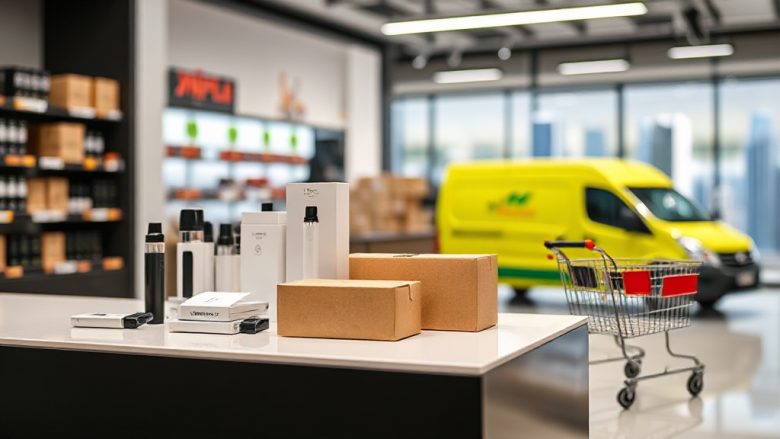
From Warehouse Shelf to Doorstep: The Retail Life of One Lana Ultra 2 Listing
The carton arrives on a Tuesday, shrink-wrapped and stacked four high on a pallet that still smells faintly of the freight container it crossed an ocean in. A warehouse worker in Singapore runs a handheld scanner across the outer label, and the beep is the first digital breath of a product that will spend the next several days becoming a listing. This particular carton holds Lana Ultra 2 units, and by the time it reaches a customer’s doorstep, it will pass through at least six distinct pairs of hands. Understanding that chain of custody is the difference between a retail operation that guesses and one that knows. Anyone browsing a storefront like lana pen plus 9k is seeing the finished surface of a process that starts long before the first click.
Stage One: Intake, Scanning, and the First Reconciliation
Intake is unglamorous and decisive. The pallet is broken down, and each carton is checked against a purchase order that was raised weeks earlier. The warehouse team counts master cases, then opens one case per batch to verify inner quantities. For the Lana Ultra 2, that means confirming that the units inside match the spec sheet: device count, flavor assortment, and the packaging revision number printed near the barcode. Discrepancies get flagged immediately, because a supplier invoice that says one thing and a physical carton that says another is a problem that compounds if it reaches the pick face.
The scan at intake creates a stock record, and that record is what a retail listing ultimately draws from. If the scan is wrong, the listing is wrong. If the count is short, the website will eventually promise a unit that does not exist. Operations teams treat this stage as the single most important control point in the entire chain, because every downstream promise — delivery windows, cash on delivery eligibility, restock timing — is built on the integrity of this first number.
Stage Two: Put-Away, Slotting, and the Logic of the Pick Face
Once counted, cartons move to put-away. Not every product earns prime real estate. Slotting is driven by velocity: fast movers sit at waist height near the packing benches, slower movers go higher or deeper. A high-rotation disposable line such as the marbo vape 25k tends to occupy a golden slot because pickers reach for it dozens of times a shift, while a newer or slower SKU might sit two aisles over until demand data justifies a move.
The Lana Ultra 2 carton is opened at put-away into individual retail boxes, and each box gets its own location code. This is where a listing stops being an abstraction and becomes a physical coordinate: aisle, rack, shelf, bin. When a customer later orders, the system does not think in product names — it thinks in coordinates. The picker receives a route, not a description. Good slotting shortens that route, and shorter routes mean faster dispatch, which is the entire basis of a delivery promise.
Stage Three: The Listing Goes Live and Demand Meets Inventory
With stock confirmed and slotted, the listing can go live. This is where retail mechanics meet consumer behavior. Product pages rarely exist in isolation; a shopper comparing options might move between a lana pix 20k and a larger-format device before deciding, and the storefront has to present accurate availability for each. Inventory accuracy is not a back-office concern — it is a customer-facing feature.
Demand signals arrive quickly. A spike in orders for one flavor or one capacity tier triggers a replenishment alert. If the Lana Ultra 2 starts moving faster than forecast, the operations team either pulls forward a purchase order or reallocates stock from a slower region. Meanwhile, related listings such as the lana pix may see secondary demand as customers explore the same brand family. Watching these patterns is how a retailer decides what to reorder and what to retire. marbo 25k
Stage Four: Picking, Packing, and the Discipline of Discretion
An order lands. The warehouse management system generates a pick list, and a worker walks the route, scanning each item into a tote. For a single-unit order, the pick takes under a minute. For a multi-item order, the picker verifies that every line matches before moving to the packing bench. This is also where substitution errors get caught: two similar-looking boxes on the same shelf are a real risk, and scanning at the point of pick is the standard defense.
Packing is where discretion becomes a process rather than a promise. Outer packaging carries no product branding, no flavor names, and no imagery that would identify the contents. Some retailers use plain mailers; others use unbranded boxes with a generic return address. The goal is consistent: the parcel should look like any other e-commerce delivery. For markets where discretion is a genuine customer priority, this stage is engineered as carefully as the pick itself, and it is one of the reasons buyers gravitate toward a storefront that publishes clear delivery and packaging policies.
Stage Five: Dispatch, Last-Mile Routing, and Cash on Delivery
Once sealed and labeled, parcels move to the dispatch cage, sorted by zone and delivery window. Last-mile routing determines whether a parcel arrives the same day or the next. In a dense city-state like Singapore, route density is high, which makes fast delivery achievable — but only if dispatch cut-off times are respected. A parcel that misses the afternoon cut-off simply waits, and the customer’s expectation resets.
Cash on delivery adds a layer of operational complexity that is easy to underestimate. The courier must carry the parcel, collect payment at the door, reconcile the cash, and return the float. Failed deliveries — wrong address, no one home, refused order — create reverse logistics work: the parcel returns to the warehouse, gets inspected, and either re-enters sellable stock or gets quarantined. Retailers that offer cash on delivery are effectively running a small financial operation alongside their logistics one. It works when the reconciliation is disciplined and falls apart when it is not.
This is also the stage where adjacent product lines matter. A customer who orders one device may later return for a different format, such as a snowwolf 16k or a heat-not-burn option like terea singapore, and the delivery experience from the first order heavily influences whether there is a second. Last-mile performance is, in practice, a retention tool.
Stage Six: Delivery, Confirmation, and the Feedback Loop
The courier hands the parcel to the customer, collects payment if required, and marks the delivery complete. That final scan closes the loop and pushes data back upstream. The warehouse now knows the unit is gone, the listing adjusts availability, and the replenishment system recalculates. If the customer leaves feedback, it feeds into the next forecast. If the customer reports a defect, the unit enters a returns workflow that traces back to the original intake batch.
Seen this way, a single product page is not a static advertisement. It is the visible tip of a relay race: supplier to freight, freight to intake, intake to slotting, slotting to pick, pick to pack, pack to courier, courier to door. Each handoff is a chance to lose accuracy, and each control point exists to prevent that loss. The next time a shopper orders a lana ultra 2, the box that arrives is the product of six stages working in sequence — and the retailer’s real job is making that sequence invisible.
That invisibility is the whole point. Customers should never have to think about slotting logic, scan discipline, or cash reconciliation. They should simply receive what they ordered, when they were told, in packaging that respects their privacy. The retail life of a single listing is short — days, sometimes hours — but the operational habits behind it are what determine whether the next listing, and the one after that, arrives just as cleanly.